

The Human Symphony
A Thousand Years of Collaboration That Gave Us One Amazing Evening

The final, resonant chord of a Vivaldi concerto hung in the air for a moment, a perfect, shimmering entity, before dissolving into the warm, dark silence of Koerner Hall. My wife and I shared a smile that needed no words. The evening was, by any measure, perfect. Tafelmusik orchestra, playing Baroque music on period instruments, transported us viscerally to another time.
Yet, what we experienced in that two-hour concert was the culmination of a vast, collaborative project spanning centuries, a silent, global orchestra of inventors, visionaries, artisans, and scholars whose collective efforts converged to bring us this single, flawless evening.
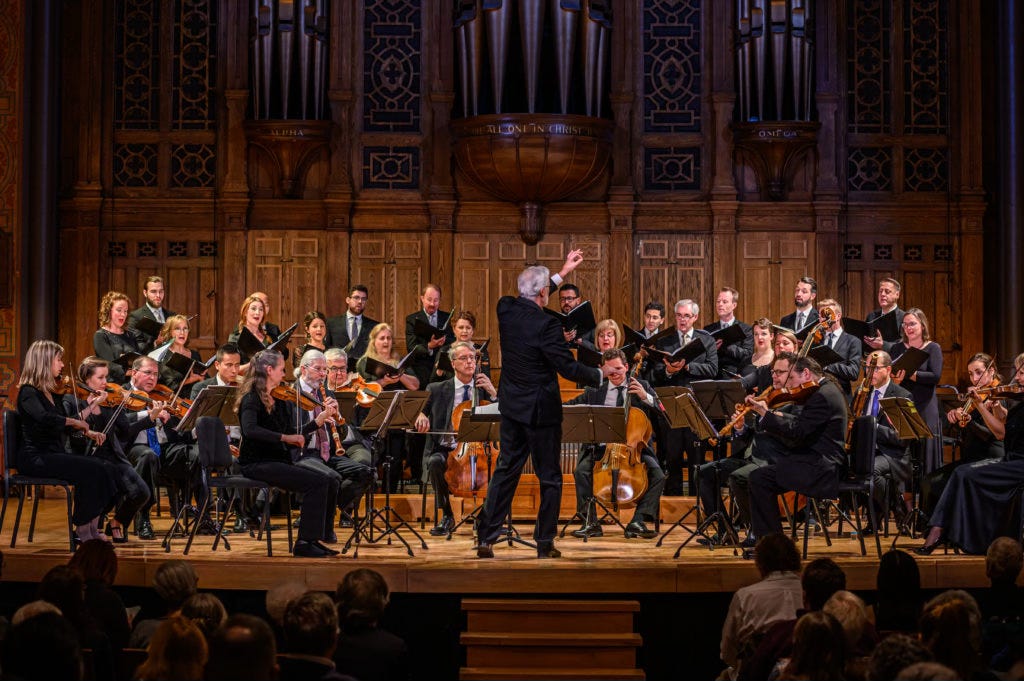
Koerner Hall itself is a testament to this legacy — a space as finely crafted as an instrument, meticulously tuned by human ingenuity. Its elegant, vineyard-style seating and soaring, wooden interior are not accidents of architecture. Its beauty and its famed acoustics are the direct result of centuries of accumulated knowledge. The architects and acoustic engineers who designed it stood on the shoulders of giants, from the builders of European cathedrals who first grappled with reverberation, to the 19th-century masters of concert hall design like Vienna’s Musikverein. They understood that a hall must not only be a vessel for sound but a participant in the music, shaping and coloring it.
The funding for such a venture, a mix of private philanthropy, institutional support, and subscriber ticket sales, represents another layer of communal faith — a modern society’s agreement that beauty and culture are worthy of investment. The chairs we sat in, the sightlines to the stage, the very air that carried the sound to our ears with such crystalline clarity, all are gifts from a long chain of planners, dreamers, and builders we will never meet.
To even comprehend the sounds we heard, humanity first had to invent a language for them. Centuries ago, in the scriptoria of medieval monasteries, an unknown innovator began drawing neumes above sacred texts, the first tentative steps toward musical notation. This system was refined over generations by Guido d’Arezzo, who gave us the staff and solfège, and by Renaissance theorists who developed the grammar of harmony and counterpoint. This language, now universal among musicians, had to be taught, painstakingly, from one generation to the next. Every music teacher in every small town, every parent who paid for a child’s first music lesson, every conservatory professor, they are all invisible links in the chain that connected the mind of a Baroque composer in 18th-century Venice to the fingers of a violinist in 21st-century Toronto. The sheet music on the stands, a miracle of precise printing and distribution, is itself a testament to this shared, inherited vocabulary.
And then, there are the instruments — the very soul of Tafelmusik’s authentic sound. The violins we marveled at, with their rich, throaty tone, are not static inventions. These instruments are the pinnacle of a craft perfected in the 17th century in the Italian workshops of Cremona, by families like the Amatis, the Guarneris, and the peerless Antonio Stradivari. Imagine Stradivari, not as a legend, but as a craftsman in his shop, smelling of varnish and wood shavings. He did not simply build a violin; he sculpted sound. He selected the spruce for the top and the maple for the back with an intuitive understanding of their resonant properties. He experimented with the arching of the plates, the thickness of the wood, the secret chemistry of his varnish — all in a quest to create a box of wood that could sing with a human-like voice.
But a violin is mute without its bow. The bow itself is a masterpiece of engineering and balance. The modern bow was largely standardized by François Tourte in 19th-century Paris. He determined the ideal curvature, weight, and use of pernambuco wood to give the player unparalleled control over articulation and dynamics. The craft of the bowmaker, or archetier, is a specialized art, separate from that of the luthier, yet equally vital. The horsehair strung upon it, treated with rosin to create friction, connects the musician’s intent to the string. Every instrument on that stage — the mellow, complex timbre of the Baroque flute, the reedy buzz of the period oboe, and the harpsichord (Mozart’s favorite instrument) — represents centuries of specialized, obsessive craftsmanship, passed down through guilds and apprenticeships, all culminating in recreating the sonic world of Baroque music we listened to that evening.
Of course, the most immediate contributors are the musicians themselves. Each member of the Tafelmusik orchestra is a living library of skill and knowledge. Their journey began in childhood, with the first squeaks and squawks of a rented instrument. It continued through thousands of hours of solitary practice — scales, études, and exercises that built the muscle memory and neural pathways necessary for fluency. They endured the frustration of difficult passages and the joy of sudden breakthroughs. They studied music theory, history, and performance practice. To play in an orchestra like Tafelmusik requires not only individual virtuosity but a profound ability to listen and blend, to subsume one’s ego into the collective sound. The conductor, too, has spent a lifetime internalizing the score, not just as a sequence of notes, but as an architectural and emotional blueprint, learning the subtle art of guiding 20 individuals to breathe and phrase as one.
This specific orchestra, with its unique mission, exists because of a particular vision. In the late 1970s, at a time when most orchestras played Baroque music on modern instruments, a few pioneering musicians had a radical idea: what if we could hear this music as the composers themselves intended? This required not only finding and playing antique instruments (or faithful replicas) but also rediscovering forgotten performance techniques, the articulations, the bowings, the lack of vibrato that defined the Baroque aesthetic. Someone — or a founding collective of musicians — had the energy and passion to turn this scholarly idea into a living, breathing institution. They secured funding, recruited talent, and built an audience, creating a global benchmark for historically informed performances of Baroque music. Their vision ensured that the concert we attended was not just a performance, but a reconstruction of a historical soundscape.
Finally, consider the event itself. While we were enjoying a preconcert dinner, a small army of administrators, stagehands, and volunteers were ensuring the evening would unfold without a hitch. A publicist wrote the press release that caught my eye. A graphic designer created the poster. A web developer built the site where I bought the tickets. An event planner coordinated schedules, and a stage crew set the chairs and stands under the perfect lighting. The usher who smiled and handed us a program was the final human link in this immense chain, gently guiding us into our seats just as the lights began to dim.
So, as we stepped out of Koerner Hall into the Toronto night, the music still echoing in our minds, we were not just leaving a concert. We were stepping away from a miracle of human collaboration. The beautiful evening was a gift, paid for over centuries by the monk who penned the first note, the luthier who carved the violin’s scroll, the composer who poured his soul into the music, and the visionary who dared to believe the past could sing again.
It was a wonderful evening because thousands of people, across oceans and generations, willed it to be so.
Spreading the Word
Are there people in your circle of family, friends, and colleagues who may be interested in this article?
As a member of the Pathfinder community, you are encouraged to forward this article to others who may find it relevant to their current situation. Every Pathfinder article is written by a highly successful senior who has now reached the stage where they want to pass on to following generations the know-how it took them decades to acquire.
We would love to hear your feedback on this article. We welcome your comments and suggested topics you would like us to write on.
We want to make The Pathfinder a community where members exchange ideas. If you want to share your story on The Pathfinder or suggest a topic for an article, please get in touch with Ron at ron.hume@rogers.com.
The Pathfinder is a not-for-profit newsletter. Consider subscribing for free or supporting us with a premium subscription to receive bonus content.